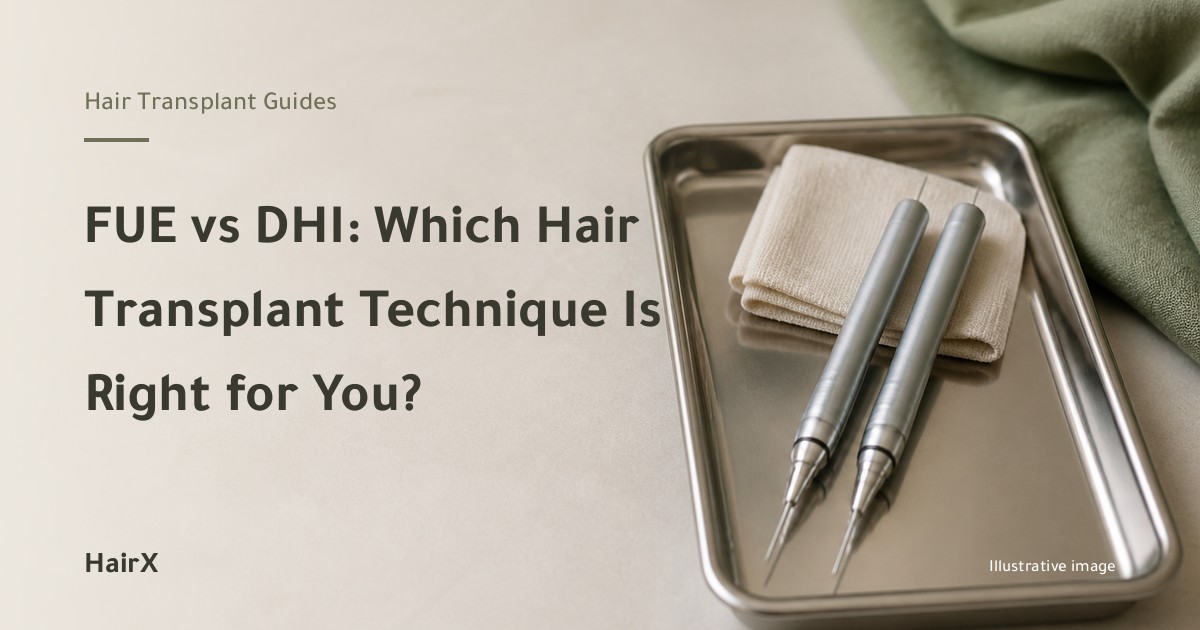
Both techniques extract follicles the same way. The difference is implantation. FUE opens recipient channels first, then places grafts. DHI uses a Choi implanter pen that opens the channel and places the graft in one motion.
DHI usually costs 20–40% more, suits unshaven work and dense packing between existing hair. FUE is generally faster for large areas. Neither is universally better — it depends on the area, your hair and the team’s skill.
Clinics market these as if one is clearly superior. It is not that simple. This guide from HairX Clinics explains the real trade-offs.
What both techniques share
This is the part most comparisons skip. FUE and DHI are not different operations — they are different implantation methods within the same operation.
In both, follicular units are extracted one by one from the donor area at the back and sides of the scalp using a fine punch, typically 0.7–1.0 mm. Both leave the same type of tiny circular healing marks in the donor area. Both use your own follicles. Both are done under local anaesthetic.
The actual difference
Classic FUE works in two stages. The surgeon first opens recipient channels across the whole area, controlling the angle, direction and density of every site. Grafts are then placed into those pre-made channels.
DHI loads each graft into a Choi implanter pen. The pen pierces the skin and releases the follicle in a single movement, so there is no separate channel-opening stage.
The practical consequences: DHI grafts spend less time outside the body, and implantation between existing hairs is easier because there is no need to pre-open channels blindly around them. But DHI is slower per graft and the pens are single-use consumables, which is where the cost difference comes from.
Side-by-side comparison
| FUE | DHI | |
|---|---|---|
| Extraction | Micro-punch | Micro-punch (identical) |
| Implantation | Channels opened, then grafts placed | Choi pen — channel and placement in one step |
| Relative cost | Baseline | Typically 20–40% higher |
| Speed for large areas | Faster | Slower |
| Unshaven option | Limited | More practical |
| Between existing hair | Harder | Easier |
| Donor marks | Same | Same |
| Healing time | Broadly similar | Broadly similar |
Which technique suits which case?
DHI tends to suit:
- Adding density between existing hair without damaging it
- Cases where full shaving is not acceptable for work or personal reasons
- Smaller, precision areas — hairline refinement, eyebrows, temples
- Women, who often cannot shave the recipient area
FUE tends to suit:
- Large bald areas needing high graft numbers in one session
- Cases where shaving is not an issue
- Situations where cost matters and the area is already bald
Marketing claims worth ignoring
Some claims made about DHI do not hold up:
“DHI has a higher success rate.” Graft survival depends mainly on careful handling, minimal time outside the body, and the skill of whoever is placing them. Both techniques can achieve excellent survival in experienced hands and poor survival in careless ones.
“DHI leaves no scars.” The donor area is extracted identically in both, so donor healing marks are the same.
“DHI means no downtime.” Healing timelines are broadly comparable.
Find out which technique fits your case
At HairX Clinics we assess your donor density, hair calibre and the area needing coverage, then recommend the technique that fits — not the one with the higher margin.
Frequently asked questions
Can both techniques be combined in one session?
Yes, and it is common. A surgeon may use DHI for the hairline where precision and angle matter most, and FUE for bulk coverage further back where speed allows more grafts in the same session.
Is DHI worth the extra cost?
It depends on your case. If you need density added between existing hair, or cannot shave, the extra cost buys something real. If you have a large bald area and no objection to shaving, the benefit is much smaller.
Does DHI hurt less?
No meaningful difference. Both are performed under local anaesthetic, and the anaesthetic injections are the uncomfortable part in either case.
What about sapphire FUE?
Sapphire FUE is standard FUE using sapphire-tipped blades to open channels instead of steel. It is a refinement of channel-opening, not a separate technique. Any benefit is modest compared with the surgeon’s skill.
How many grafts can be done in one session?
This depends on your donor supply, not the technique. Sessions commonly range from 2,000 to 4,000 grafts. Pushing beyond what your donor area can safely spare risks visible thinning at the back — a permanent problem.
Do you have to shave your head for a hair transplant?
You do not have to shave your whole head for a hair transplant: unshaven DHI extracts and implants grafts within the existing hair, so the surrounding length covers the work while it heals. The trade-off is real — unshaven work is slower, costs more per graft, and caps how many grafts can be placed in a single session, which makes it better suited to hairline refinement and smaller cases than to full-scalp coverage. Most clinics still trim or shave a strip in the donor area at the back, which longer hair above it hides. HairX Clinics recommends shaved or unshaven based on the area being treated and the graft count, not as a package upgrade.
Can you get a hair transplant without shaving your head?
Yes — an unshaven hair transplant is possible, and it is normally done with DHI implanter pens, which place each graft between existing hairs without needing a clear field to work on. It suits patients who cannot take visible downtime, and it works best up to roughly 2,000 grafts; beyond that, most surgeons will advise shaving because the session length and graft handling time start to work against survival.
What is the best hair transplant method?
There is no single best hair transplant method, because FUE, DHI and sapphire FUE all extract follicles the same way and differ only in how the channels are opened and the grafts are placed. The variable that actually changes the result is who performs the procedure and how many grafts they personally handle, not which named technique appears on the quote. A clinic that recommends the same technique to every patient is selling a product rather than planning a case.
What is FUT hair transplant?
FUT, or follicular unit transplantation, is the older strip method: a strip of skin is removed from the back of the scalp, the donor site is closed with sutures, and the strip is dissected under magnification into individual grafts. It leaves a permanent linear scar across the donor area, which is why it has largely been replaced by FUE in cosmetic practice — but it is still used in specific cases, because a strip can yield a very high graft count in one session and it spares the surrounding donor follicles that FUE punches remove. If you intend to wear your hair very short at the back, FUT is the wrong choice.
The bottom line
DHI is a variation of FUE, not a rival to it. The extraction is identical; only implantation differs. DHI costs more and suits unshaven and precision work. FUE is more efficient for large areas.
Choose the clinic and the team first. The technique is a detail they should recommend based on your scalp — not a product you pick from a menu.
See your result before you book. A full year of it, from photos on your phone.
HairX is the first hair transplant clinic in the world to show you the twelve-month result and the graft count you need before you speak to anyone. It is free and it takes minutes. The report covers your stage of hair loss, what your donor area can realistically give, and how the result comes in month by month, including the third month, when it looks worse before it gets better.