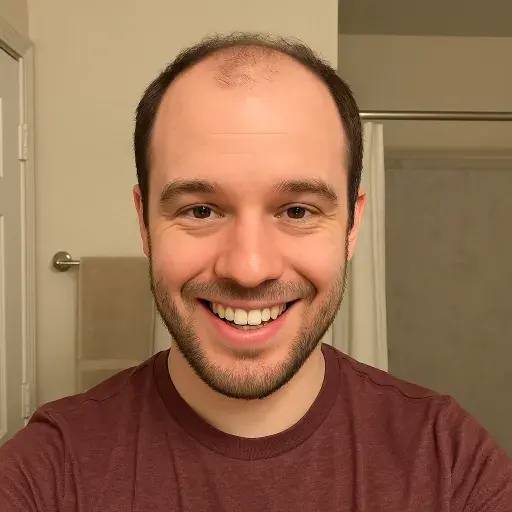
Most results that look like failures at month three are not failures at all — the transplanted hair sheds within weeks and regrows from around month four, so month three is often the low point. A result can only be fairly judged at twelve months.
A genuinely poor result is a different matter, and your recourse across a border is slower and narrower than it would be at home. Which is why the four things that matter are agreed before you travel, not after.
This is the question clinics are least keen to answer, so HairX Clinics has written the answer down. It covers how to tell a normal phase from a real problem, what revision actually involves, what recourse exists when the clinic is in another country, and what to put in writing before you book anything.
Is it a poor result, or a normal phase?
Start here, because most people who believe their transplant has failed are looking at an expected stage of it.
| What you are seeing | What it usually is |
|---|---|
| Transplanted hairs falling out at weeks two to six | Expected shedding. The follicle stays; the shaft is released |
| The area looking thinner at month three than before surgery | Often shock loss of surrounding native hair, which typically recovers |
| Growth arriving patchily at months four to six | Normal. Follicles do not restart in unison |
| The crown lagging behind the front at month nine | Normal. The crown is consistently the slowest area |
| Redness persisting for weeks, particularly on fair skin | Common and self-limiting |
| Pain, spreading redness, heat, pus or fever | Not a phase. Seek medical attention the same day |
When can a result be fairly judged?
Twelve months, and eighteen for the crown. That is not a clinic buying time; it is the biology of the follicle cycle. Judging at month four means judging the shedding phase, and judging at month six means judging roughly half of the growth you will eventually have.
The practical consequence is that you should not book a revision, demand a refund, or write a review at month four. You also should not spend those months alone with the worry, which is what a proper follow-up schedule is for: our recovery guide sets out what is normal week by week.
What kinds of poor result are there, and which are fixable?
They are not equivalent, and it matters a great deal which one you have.
- Insufficient density. The most common complaint and usually the most fixable — a second session can add grafts to the same area, provided your donor area can supply them.
- Poor angle or direction. Hairs that stand up rather than lying in the natural flow. Partially correctable, sometimes by removing and re-placing grafts, which costs donor supply.
- A badly placed or badly shaped hairline. The hardest problem in the field. A hairline set too low or too straight ages badly, and correcting it may require removing grafts as well as adding them. Prevention here is worth more than any guarantee.
- An over-harvested donor area. Visible thinning or patchiness at the back and sides. This is the one that cannot be undone. Follicles taken from the donor area do not grow back, and no revision restores them.
- Visible scarring. Extraction scars are normally small and dispersed; when extraction has been aggressive or the sites poorly spaced, they can show at short hair lengths.
What should you do first?
- Document it. Photographs in consistent light, same angles, dry hair, same length, dated. A sequence over months is worth far more than one photograph taken on a bad day.
- Go back to the operating clinic first. They have your graft plan, your donor map and your operative notes. Even if you have lost confidence in them, their records are part of any assessment anyone else will make.
- Ask for the assessment in writing. What they consider the outcome to be, against the plan that was agreed, and what they propose.
- Get a second opinion at twelve months, not before. A surgeon who has not operated on you can assess density, angle, hairline design and donor status independently.
- Deal with any medical problem locally and immediately. Infection, unusual pain or bleeding go to a doctor where you are, in parallel with contacting the clinic.
What recourse do you actually have across a border?
Less than you would have at home, and it is better to know that now.
A revision is a matter of the clinic’s own policy, which is why that policy needs to exist in writing before you pay anything. Formal complaint routes run through the health authority of the country you were treated in, and they are slower and harder to navigate from abroad. Legal action across jurisdictions is possible in principle and rarely proportionate in practice for the sums involved.
Insurance is usually not the answer either. Travel policies commonly exclude elective surgery abroad and its complications, and the exclusion often extends to the consequences. Read your own policy wording rather than assuming, and read it before you fly.
If you paid by credit card, the payment protections available in your own country may apply to the transaction — the rules differ by country and by how the payment was made, so check with your card provider rather than relying on general advice.
Start with a plan you can hold anyone to
Our free hair analysis returns an estimated graft count for every zone of your scalp, a written surgical rationale, a visualisation of day one, month three, month six and month twelve, and a PDF you keep. A plan in writing is what makes a result assessable later — and the PDF is yours to take to any clinic you are considering, including ones that are not us.
What to agree in writing before you travel
Four things. Ask any clinic, anywhere, including this one, and keep the answers.
- The plan. Graft count, which zones, which technique, and what is being left in reserve in the donor area. Without this there is no standard to measure the outcome against.
- The follow-up schedule. Fixed intervals with a named person — one week, one month, three months, six months, twelve months. At HairX that follow-up runs in person for patients in Egypt and online for those who have flown home.
- The revision policy. What triggers it, who assesses it, at what point it is assessed, what it covers, and who pays for what — including travel.
- The escalation route. Who you contact out of hours, how fast they respond, and what they will tell you to do locally in an emergency.
A clinic that answers those four plainly and in writing is telling you something real about how it operates. One that will not is also telling you something.
The bottom line
Wait for twelve months before you judge. Treat infection as urgent and everything else as a conversation. Go back to the operating clinic first, in writing. Understand that across a border the protection is the verification you did beforehand, not the remedy you find afterwards.
And if you are still at the stage of choosing, weight your decision towards the clinic that will put the plan, the schedule and the revision policy in writing — not the one with the best photographs.
My transplanted hair fell out after three weeks. Has it failed?
Almost certainly not. Transplanted hairs commonly shed within the first weeks while the follicle remains in place, and regrowth generally begins around month four. This is the expected course rather than a complication.
Can a bad hairline be corrected?
Partially, and it is the hardest correction in the field. Softening a hairline that was placed too low or drawn too straight can involve removing grafts as well as adding them, and it consumes donor supply. This is why the design discussion before surgery matters more than any policy afterwards.
Will the NHS fix a hair transplant that went wrong abroad?
NHS services treat urgent medical problems such as infection, as they would for any patient. They do not revise or correct cosmetic outcomes. See our guide to hair transplants and the NHS.
How long should I wait before asking for a revision?
Twelve months for most areas and up to eighteen for the crown. Requesting a revision earlier usually means requesting it on incomplete evidence, and most clinics assess at the twelve-month point for that reason.
Can an over-harvested donor area be repaired?
Not restored. Follicles removed from the donor area do not regrow. Camouflage options such as scalp micropigmentation exist and can reduce the visible contrast, but the supply itself is gone, which is why donor planning is the part of the consultation worth the most attention.
See your result before you book. A full year of it, from photos on your phone.
HairX is the first hair transplant clinic in the world to show you the twelve-month result and the graft count you need before you speak to anyone. It is free and it takes minutes. The report covers your stage of hair loss, what your donor area can realistically give, and how the result comes in month by month, including the third month, when it looks worse before it gets better.