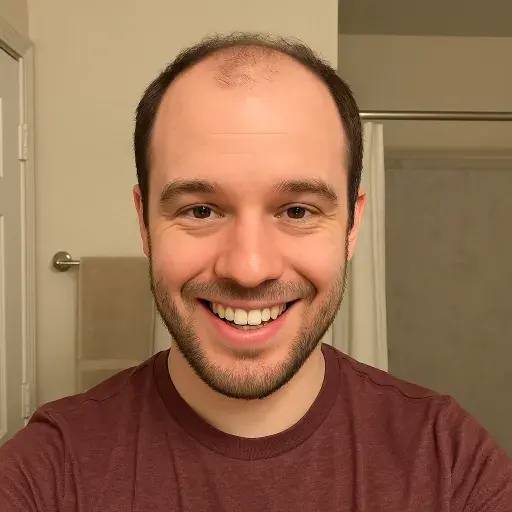
A hairline transplant moves your own hair follicles from the back of the scalp to rebuild a receded front hairline. Most cases need 1,500 to 2,500 grafts and take one session.
What separates a natural result from an obvious one is not the technique — it is the design: where the line sits, how irregular its edge is, and the angle each follicle is placed at.
The hairline is the hardest part of any transplant to get right, and the only part everyone sees. This guide from HairX Clinics explains what actually determines whether a hairline looks like it grew there.
What makes a hairline look natural?
Four things, and none of them are the machine used:
| Element | Why it matters |
|---|---|
| Irregularity | A real hairline is never a straight line. It has soft peaks and gaps. A ruler-straight hairline reads as artificial from across a room |
| Single-hair grafts at the front | Natural hairlines start with fine single hairs, then transition to two- and three-hair groups further back. Placing multi-hair grafts at the very front creates a doll-like edge |
| Angle and direction | Front hairs grow forward at a sharp angle, almost flat to the skin — not straight up. Wrong angle is the most common giveaway and is very hard to correct later |
| Density gradient | Density should build gradually from front to back, not start dense at the edge |
Where should the hairline sit?
Surgeons typically place the central point of a new hairline roughly 7 to 10 cm above the glabella (the area between the eyebrows), adjusted for face shape, height and skull proportions.
The temptation is always to go lower. Resist it. A low hairline looks impressive at 30 and wrong at 50 — because hair loss keeps progressing behind it while the transplanted line stays fixed. You end up with a dense strip in front and a bald area behind it.
How many grafts does a hairline need?
| What you are correcting | Typical graft range |
|---|---|
| Slight temple recession only | 800 – 1,500 |
| Full hairline reconstruction | 1,500 – 2,500 |
| Hairline plus frontal third | 2,500 – 3,500 |
| Hairline plus mid-scalp | 3,500 – 4,500 |
These are planning ranges, not quotes. The real number depends on your donor density, hair calibre, hair-to-skin colour contrast and how large an area needs covering. Coarse hair covers more ground per graft than fine hair.
Why your age changes the plan
Hair loss is progressive. A transplant treats the area operated on — it does not stop loss elsewhere.
This is why a responsible clinic will ask about your family history, look at your current pattern, and often recommend medical treatment alongside surgery to slow further loss. Someone in their early twenties with a fast-progressing pattern may be advised to wait or to stabilise medically first. A clinic that will operate on anyone who walks in, at any age, is telling you something.
Warning signs of a poorly planned hairline
- A straight, sharply defined edge with no irregularity
- Hairs standing upright at the front instead of angled forward
- Visible clumps of three or four hairs at the leading edge
- A hairline placed very low on a young patient with active loss
- No discussion of your donor area before a graft number is quoted
- A price quoted before anyone examined your scalp
See your hairline design before you commit
At HairX Clinics we assess your donor area and loss pattern, then map the proposed hairline on your own scalp so you can see the plan before agreeing to anything.
Frequently asked questions
Will a hairline transplant leave scars?
FUE extraction leaves tiny circular marks in the donor area, typically under 1 mm each. They fade over months and are generally not visible at normal hair length, though they can show if you shave to the skin. In the recipient area, healing marks fade as the skin settles.
How long until the hairline looks finished?
Transplanted hairs shed within the first few weeks — this is expected and not a failure. Regrowth begins around 3 to 4 months, meaningful density appears by 8 to 10 months, and the final result is usually judged at 12 to 18 months.
Can a badly done hairline be fixed?
Often, but it is harder than doing it right initially. Repair work may involve removing or redistributing misangled grafts and adding fine single hairs to soften the edge. It consumes donor supply that could have gone to new coverage, which is why the first attempt matters so much.
Do I need to shave my head?
Not always. Some clinics offer unshaven or partially shaven approaches, particularly with DHI. These take longer and may cost more, and suitability depends on the size of the area and your hair length.
Is the procedure painful?
The procedure is done under local anaesthetic, so you should not feel pain during it. The anaesthetic injections are the uncomfortable part. Mild soreness and swelling for a few days afterwards is normal and usually managed with simple pain relief.
How do you know if your hairline is receding?
You can tell a hairline is receding when it moves back unevenly — the temples retreat first and faster than the centre, leaving a forehead that reads as M-shaped rather than straight. A mature hairline that simply settles about a centimetre above the highest forehead crease in the late teens or twenties is normal and then stops; a receding one keeps moving. The reliable test is not the mirror but time: photograph your hairline every three months in the same light and at the same angle, hair dry and pushed back, and compare the set. Hairs at the edge that are noticeably finer and shorter than the rest are miniaturising, and that is the earliest visible sign of all.
What causes a receding hairline?
A receding hairline is caused in the great majority of men by androgenetic alopecia: follicles at the temples and front are genetically sensitive to DHT, which shortens each growth cycle until the hair produced is too fine and too short to cover. It is inherited from both sides of the family, not only the mother’s. Other causes behave differently — traction from tight hairstyles pulls the front line back mechanically, and telogen effluvium after illness, surgery or severe stress thins diffusely and then recovers. Only the genetic kind is progressive and permanent, which is why identifying which one you have has to come before deciding what to do about it.
How do you fix a receding hairline?
Three things work on a receding hairline, and only one of them restores what has already gone. Minoxidil and finasteride slow or halt further recession and can thicken hair that is still miniaturising, but they cannot regrow a follicle that has died. A hair transplant moves DHT-resistant follicles from the back of the scalp into the receded area, and it is the only route to rebuilding a line that is gone. Scalp micropigmentation creates the appearance of density without adding hair. Nothing applied topically — oils, serums, or the products marketed as regrowing a hairline — has evidence of reversing genetic recession, and the months spent testing them are months the recession continues.
The bottom line
Technique matters less than design. FUE and DHI can both produce excellent hairlines or obvious ones — the difference is the judgement behind where the line sits, how its edge is broken up, and the angle every graft is placed at.
Before you book anywhere, ask to see the proposed hairline drawn on your own scalp, and ask how many grafts are being reserved for future loss.
See your result before you book. A full year of it, from photos on your phone.
HairX is the first hair transplant clinic in the world to show you the twelve-month result and the graft count you need before you speak to anyone. It is free and it takes minutes. The report covers your stage of hair loss, what your donor area can realistically give, and how the result comes in month by month, including the third month, when it looks worse before it gets better.